EDITORIAL: Flávio Bolsonaro must honor the Brazilian Republic and accept the election result
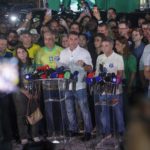
Shortly after the result of the election in which Brazil chose to re-elect Luiz Inácio Lula da Silva with 64.2 million votes, Senator Flávio Bolsonaro announced it was “impossible” to acknowledge his defeat and said he would seek to have the runoff annulled in court. A decision of such gravity requires compelling justification. But there is none.
Flávio emerged from the election stronger than many on the right had assumed possible back when his father chose him to run for president. With 59.8 million votes, he surpassed Jair Bolsonaro’s totals in 2018 and 2022 and despite losing his first presidential race, he established himself as a competitive candidate capable of bringing millions of supporters to the streets. It is now imperative that he not diminish himself to play the role that led his father to prison, one of his brothers into self-imposed exile and inspired thousands of people to put their families’ futures at risk in an uprising against democracy and the Constitution.
It is easier to be magnanimous in victory than in defeat. From its statesmen — as the senator spent months presenting himself to the country — the Brazilian Republic demands the courage to accept defeat and the example of someone who puts the public interest above pride and partisan calculations.
It is striking that the basis of his challenge is a court decision that gave Brazilian citizens more time to exercise their right to vote, especially after his own campaign asked the electoral court to extend voting hours in five states. That request itself acknowledged that the deadline was not absolute and could be extended in extraordinary circumstances.
If heavy rains in the Southeast and South made it harder for a significant number of voters whom the senator considered his supporters to reach polling stations, the same was true of the lack of public transportation in Salvador, the city that delivered Lula his largest net vote advantage. The aggravating factor is that this was not a natural phenomenon, but the result of decisions by political and business actors, for reasons that remain unclear.
JOTA reporters visited bus garages in Salvador and saw vehicles sitting idle without the impediments cited by the city’s public transport operators. To prevent well-founded suspicions that voter suppression has become a tool of electoral competition in Brazil, the case must be investigated seriously.
The fact that the decision to extend voting was made by a Supreme Court justice rather than by the Superior Electoral Court (TSE) may irritate a political camp that has clashed with the Supreme Court in recent years, and may expose undesirable tensions between the courts. But it is impossible to deny that, in its role as guardian of the Constitution, the Supreme Court acted to allow the people (from whom all power emanates, according to the 1988 Constitution) to exercise their civic right and duty more fully.
Flávio Bolsonaro also accuses a TSE led by justices appointed by his father of preventing Liberal Party (PL) election monitors from entering the court’s secure server room. The court explained that access to the room, which houses the computers used to tabulate votes, has always been restricted for technical and security reasons.
There is still time to change course. Flávio Bolsonaro reacted to his first-round lead by allowing allies to focus on assembling a government they had not yet won, while he spoke of changing the Constitution. Faced with negative reactions from the public and polling, he pulled back from those ambitions. It is once again time for restraint. Out of respect for the Constitution and the millions of Brazilians who placed their trust in his ability to lead. And honoring the commitment he made during the campaign to respect the result at the ballot box.
The country faces serious and urgent domestic and international challenges. The opposition has been strengthened in Congress and can contribute to necessary reforms while ensuring that the voices of the significant share of voters who did not elect the president continue to be heard.
A message of serenity from Senator Flávio Bolsonaro would go down in history as a gesture worthy of the millions of votes he received.
(Texto traduzido para o inglês por Euan Marshall)